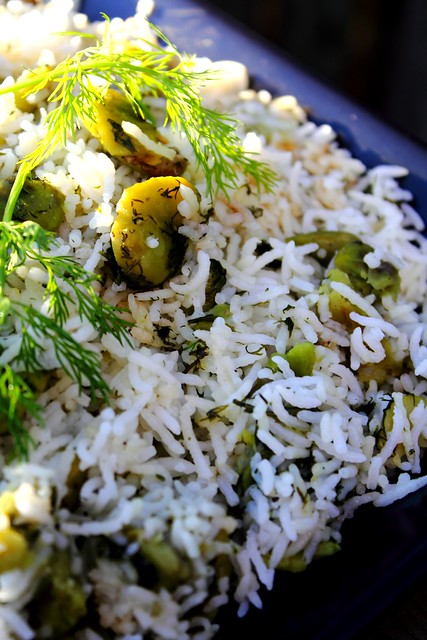
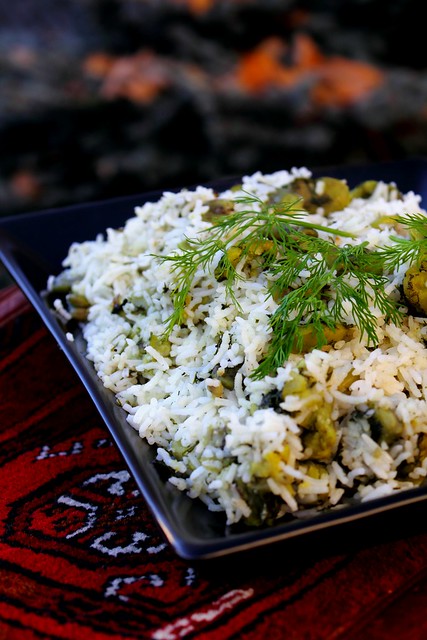
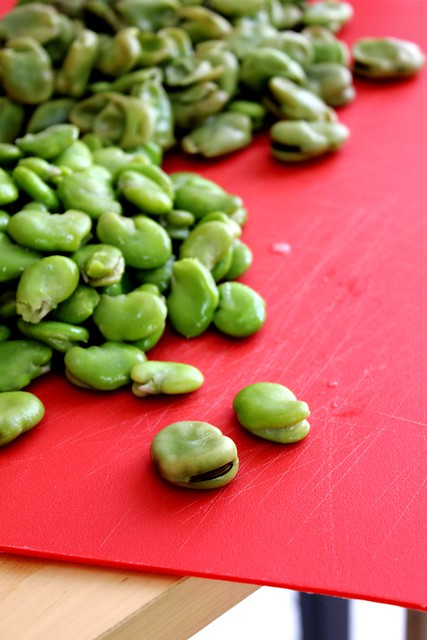
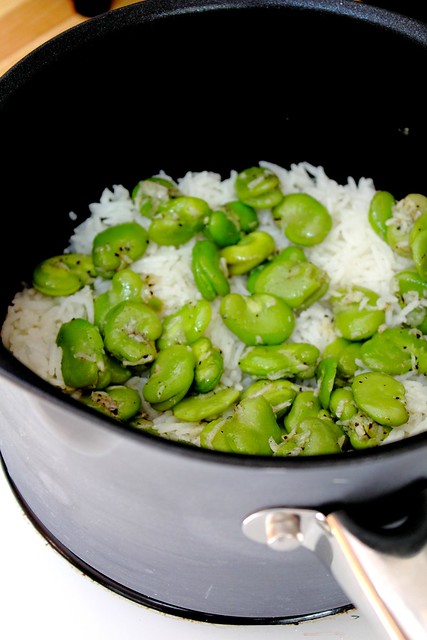
Here is a familiar dish that I recently learned had roots in Persia. My mother was introduced to this dish by my sister's childhood Kurdish friend when her mother brought a plate of it over to our house. It's a dill and fava bean rice, known as Baghali Polo in Persian Cuisine.
Favas in Arabic are Baqila, and they are very popular all over the Middle East. In Iraq they are known as Bajila and the dry form is boiled and served as a nice soup - introduced to you hopefully in another post sometime - and the green form is also cooked in this Persian style rice.
All that said I doubt they are as pouplar anywhere as in Egypt, where it is a hearty rustic dish that everyone is familiar with and known as "foul mudamas"
Just like peas and mint are a pouplar combination favas go beautifully with Dill, Shbint in Kurdish or Shibitt in Arabic and Farsi or sometimes Sheveen in Farsi too.
The rice my mother knew was made with a round calarose type rice in Kurdistan but upon searching almost all the Persian recipes were made with a nice fluffy basmati, and being my favourite rice I thought to go with it.
I've combined two recipes that I found online but it's a simple recipe.
-Lots of chopped fresh dill
-Shelled green baby favas (I had thawed from frozen)
-Soaking basmati in salted water for a few hours
-Took the recommendation from one recipe to sautee the fava with some garlic and set aside
-Bring Basmati to a boil for 10-12 mins in a big pot of salted water, drained and rinsed.
Then it was all assembled layering the rice over some oil and a few drops of water and then adding dill, fava and more rice until the last layer was rice. Making holes in the rice and steaming on high for 8 mins or so then adding a bit of water (less than half the amount of rice) and steaming with a lid covered in a kitchen towel for 40 mins or so on a low setting.
A little melted butter can be added to the top when it's done then flipped out onto a pan and gently arranged for serving.
Next time I'd like to add more dill, lots more and see what other things I can do to learn how to perfect the cooking process. I'd also like to add more chopped dill to it after it's cooked because I like the fresh taste.
Any tips and ideas are welcome, feel free to comment and let me know what you think.
Haven't had much to post lately, the weather seems to be changing day to day, two days ago it was sunny, then cloudy and now rainy, typical spring weather I guess.
Thank you all for your kind - get well soon - wishes :) I'm feeling a lot better and hopefully by next week this flu will be completely gone.
Today I've decided to post some mini video clips on a simple dish I prepared a while ago, the photo as usual went up on flickr. Okra is not something that most people are familiar with or enjoy, however in the middle east it is VERY popular and one of my favourite dishes since childhood, It's fairly simply and very yummy, usually made with beef stewing chunks but can also be made vegetarian.
Types of Okra (known as bamia in arabic) are fresh, frozen, canned or even dry.
Fresh okra can be boiled in a light salt water for a bit before adding into the sauce or can be added directly, canned should always be strained well and added at the very end because they're already cooked. Frozen can be added at boiling point and right before simmering.
Ingredients:
- few tbsp Oil
- 4 medium garlic bulbs, skinned and slivered.
- 1 package frozen okra
- 1 jar of strained tomato
- salt/black pepper
Rice:
- Oil
- 3 cups Calrose rice
- 1/2 cup Vermicilli noodles
- Salt
1 3/4 cup water per cup of rice.
If you're going to add stewing beef, saute/brown it with the garlic and then add tomato and boiled water then allow to simmer until it's done. Once the meat is tender add the okra and simmer a little bit more for the flavours to blend.
I'm a thirty-something Canadian girl inspired by my rich & very diverse (Africa-Europe-Asia....) heritage! Join me here for an adventure in food, lifestyle and all good things with a touch of exotic.